
Scale in software
Deploy a compact virtual instance or size for large centralized voice environments using per-session licensing.
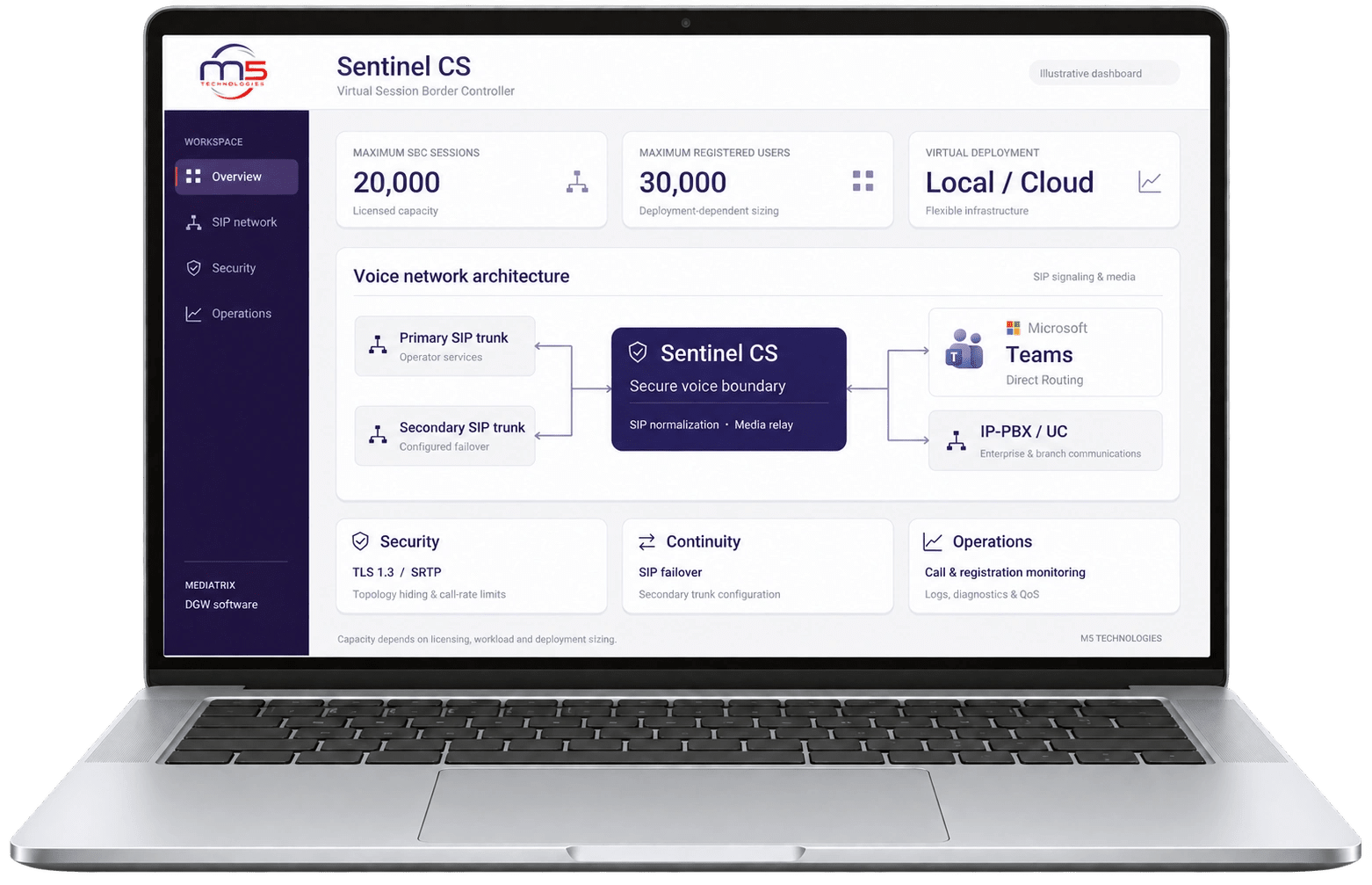
A software-based Sentinel SBC for local or cloud virtual infrastructure, supporting up to 20,000 sessions and 30,000 registered users.
Evaluation terms will be defined with our team based on your project.
Sentinel CS is the software-based Sentinel SBC for private cloud, public cloud and virtualized infrastructure. It delivers the same DGW secure SIP functions used across the Sentinel portfolio without dedicated hardware.
Deploy a compact virtual instance or size for large centralized voice environments using per-session licensing.
Advanced rules, call admission control, NAT traversal, codec policy and SIP manipulation normalize diverse voice networks.
TLS 1.3, SRTP, topology hiding, X.509 certificate management, DoS protection and rate limiting secure the boundary.
Download the PDF files directly. Use the documentation portal for configuration guides, installation procedures and release-specific information.
A product decision is only correct when both sides of the interface, the security boundary and the operating model are considered together.
Local phones, a local IP PBX, Mediatrix gateways and Sentinel can exchange SIP calls entirely inside the organization. The voice path can remain on a private LAN, VLAN, campus network or isolated operational network.
An external connection is used only when calls must reach public numbers, remote sites or hosted services. If the required call path is entirely local, the system can stay on the private network.
Customer-controlled compute hosts the virtual SBC instance.
Approved calls reach phones, agents and business applications.
Analog phones, fax, modems or PBXs can enter the SIP architecture without bypassing policy.
Virtual SBC deployed on supported local or cloud virtual infrastructure.
Cloud users connect through a certified Direct Routing boundary.
Public numbers and inbound or outbound calling arrive from the service provider.
Conceptual architecture — final topology, capacity and interface configuration require validation.
Start with scale and deployment model, then validate interfaces, high availability, carrier interoperability and lifecycle requirements.
Published maximums are selection guides, not a substitute for sizing against codec, transcoding, recording, redundancy and traffic assumptions.| Selection factor | Sentinel Mini | Sentinel 100 | Sentinel 400 | Sentinel CS |
|---|---|---|---|---|
| Deployment | Compact appliance | 1U appliance | Modular 1U appliance | Virtual / cloud |
| Concurrent sessions | Up to 400 | Up to 120 | Up to 2,000 | Up to 20,000 |
| Registered users | Up to 1,200 | Up to 500 | Up to 6,000 | Up to 30,000 |
| Legacy voice | External gateway | Optional interfaces | Modular PRI / BRI / FXS / FXO | External gateway |
| Typical fit | Branches and focused edges | SMB and hybrid sites | Large hybrid voice environments | Centralized and cloud voice |
Share the product, deployment and target outcome. M5 will identify the right technical and commercial path.